What exactly do back-end and front-end developers do?
An interview with Felix Hoffmann and Patrice Voß

Imagine you’ve got products that you want to sell online – but, unfortunately, you don’t know how to set up and maintain an online shop. Then you need the expertise of a front-end developer like Patrice Voß and a back-end developer like Felix Hoffmann. Both are part of the Java Software Engineering Team. In Jena, Patrice programs the area of our online shop that customers can actually see, which is called the front end. In Zeulenroda, Felix programs the hidden part of the shop, which is called the back end. This is where commands that users enter in the online shop are processed. Together, Patrice and Felix provide an insight into their work.
What work does your team do and which departments do you cooperate with most?
Patrice: Together with eight other colleagues, we ensure that everything runs smoothly in the Bauerfeind shops for business customers and consumers, as well as in the shops for Berkemann, Solidus, MarcShoes, and Uniprox. So in total, we take care of eight different online shops. We work very closely with different specialist departments that provide us with the requirements for functions that need to be implemented as well as their design. When the technical structure has been set up, we are in close communication with Content Managers who add content like text and images.
Felix: We also make sure that the industry software used by medical supply retailers and our measurement technology are connected correctly. Then we transmit the data from the online shop to the subsequent systems so that ordered products can usually be manufactured on the same day. Together with an external service provider, we also ensure the continuous operation of the online shop systems so they are always accessible for our customers.
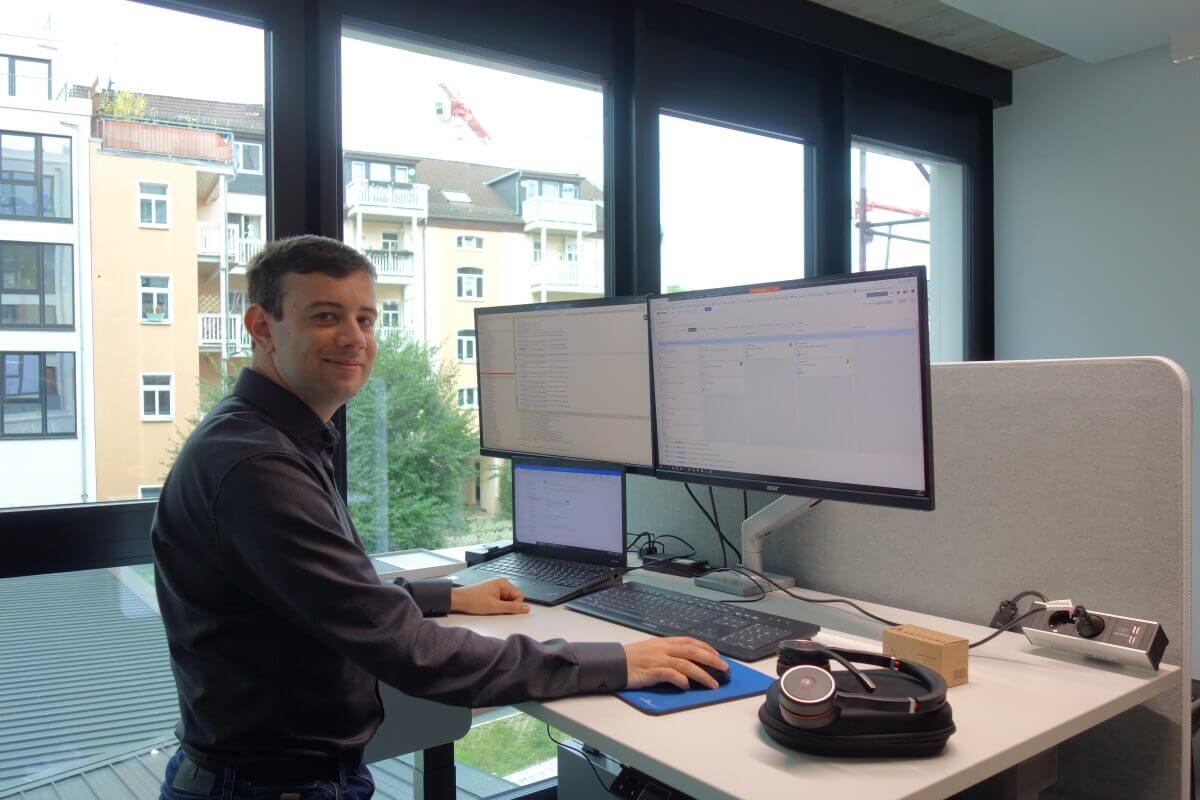
Felix, you are the Back-end Developer, Patrice, you’re the Front-end Developer. In what way is your work different?
Patrice: In joint interaction, we ensure that the online shop is set up logically and that everything that can be clicked on works properly. Imagine it this way: there is a shared back end for all of Bauerfeind’s shop pages. That’s a huge platform on which we develop all functionalities for all the shops. For each shop, there are then different front-end pages. As the Front-end Developer, I ensure that, in the visible area of the shop pages, the typefaces and colors are defined consistently, buttons and input fields are positioned correctly, and everything can be used intuitively by the customer.
Felix: Most colleagues in the team work on back-end development. That’s where the entire logic and data processing of the online shops are hiding, as well as interfaces with connected systems. If there is a new product, for example, the size selection has to be programmed in such a way that, after the measurements have been recorded – using measurement technology or manually in the medical retail store – the correct sizing suggestion is made for the product.
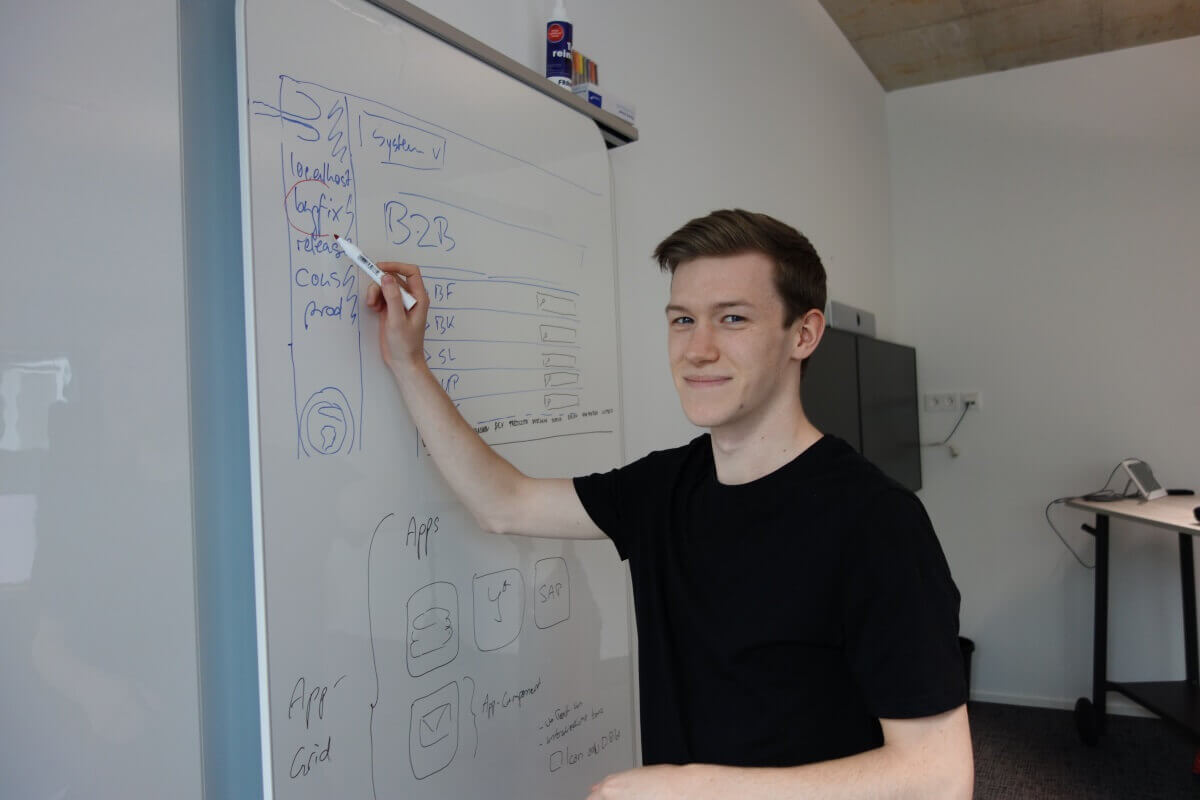
Does that mean that you, Patrice, as a Front-end Developer, implement what Felix programs in the back-end?
Patrice: That’s exactly it! I implement his work creatively and can directly check in the browser if something is working or what something looks like for the user in the end.
Felix: As Back-end Developers, we work more “in the shadows” and look at data directly. Using automated test cases, we check whether we’re providing the right data that is subsequently displayed by Patrice on the front end. Something that may just be a small change for the user on the front end can sometimes be a real challenge for us.
Do you have an example of that?
Felix:One of the most recent major features we implemented for the Bauerfeind business customers’ online shop was the option of digitally recording returns. In the order process, customers can look up an item they want to return and record it with a reason for the return. Once the return has been accepted by us, the customer can print the return note and parcel label right from the online shop. There’s also the option of requesting a parcel service to collect the parcel from the customer’s store.
Patrice: On the front end, this is merely one function among many. The customer can just place the return request with a few clicks. But on the back end, we really had to put a lot of work into this. Depending on which products the customer wants to return, they are either automatically approved or subjected to an inspection by a Customer Service Team Member. So this also required an internal view for our Customer Service colleagues so the incoming requests can be assessed quickly. Plus, the interface with the parcel service had to be incorporated so the parcel label and collection of the parcel in the customer’s store can conveniently be dealt with via the online shop.
That sounds technically sophisticated. What training is needed to work for your team?
Felix: Being able to work as part of a team is important, supporting each other. And knowing a programming language is helpful, too, of course. One crucial ability, be it for Back-end or Front-end Developers, is logical thinking so we can digitize existing processes and make them intuitive for the customer. Both a degree in information technology and an education to become an IT specialist, like Patrice completed, are perfect for this.
How the team structures its work:
The Java Software Engineering Team uses the model of agile software development.
This means that there are no lengthy planning phases, because the issues dealt with are so complex that new challenges often only occur during the development phase. The work is therefore structured in three-week cycles. In a “sprint planning” session, all developers get together and divide the relevant tasks for the subsequent three weeks. Issues are dealt with together in daily meetings. After three weeks, a joint review with the specialist departments takes place where the Development Team presents the results of the previous three weeks. After that, the team summarizes what worked well and what didn’t, derives improvements, and plans the next three-week cycle.