3D Print
The dynamic duo

The updated version of the BODYTRONIC ID:CAM system solution with additional 3D print option was launched at the beginning of January. Foot Orthopedics Product Managers Nadine Ludwig and Michael Seidler played a crucial role in its development. They shared their insights into this project in our interview.

Bauerfeind and 3D print – what exactly is that about?
Nadine: BODYTRONIC ID:CAM is our web application or system solution that medical retailers can use to digitally model foot orthoses. Previously, the foot orthoses would then be milled by Bauerfeind. But with the new version, foot orthoses can now also be produced via 3D print – either undertaken by the medical retailer or centrally by Bauerfeind.
Michael: What’s special about this is that we don’t offer standard series-printed products but a customized 3D printing process. This means medical retailers can now be even more flexible and manufacture more personalized products.
How long have you been thinking about this idea?
Nadine: For about five years. The project really gathered momentum when we realized how relevant it is for the market – in terms of competition as well. After we got the Executive Board’s approval two years ago, we were able to properly focus on our individual 3D print concept. We first set up a taskforce with colleagues from the Sales Department. They provided us with requests and suggestions from customers in the field, and then we had a look together whether we were able to implement those things and how.
And you were never in doubt that you would use the BODYTRONIC ID:CAM for that?
Nadine: We never even considered series printing. Neither did we want new software but we wanted to keep using the BODYTRONIC ID:CAM as individual foot orthosis software. Together with our service provider Voxelcare, we then developed a concept that was fully tailored to our requirements.
Michael: We didn’t use anything “off-the-shelf”. Materials, modules, illustrations – everything was adapted to our needs.
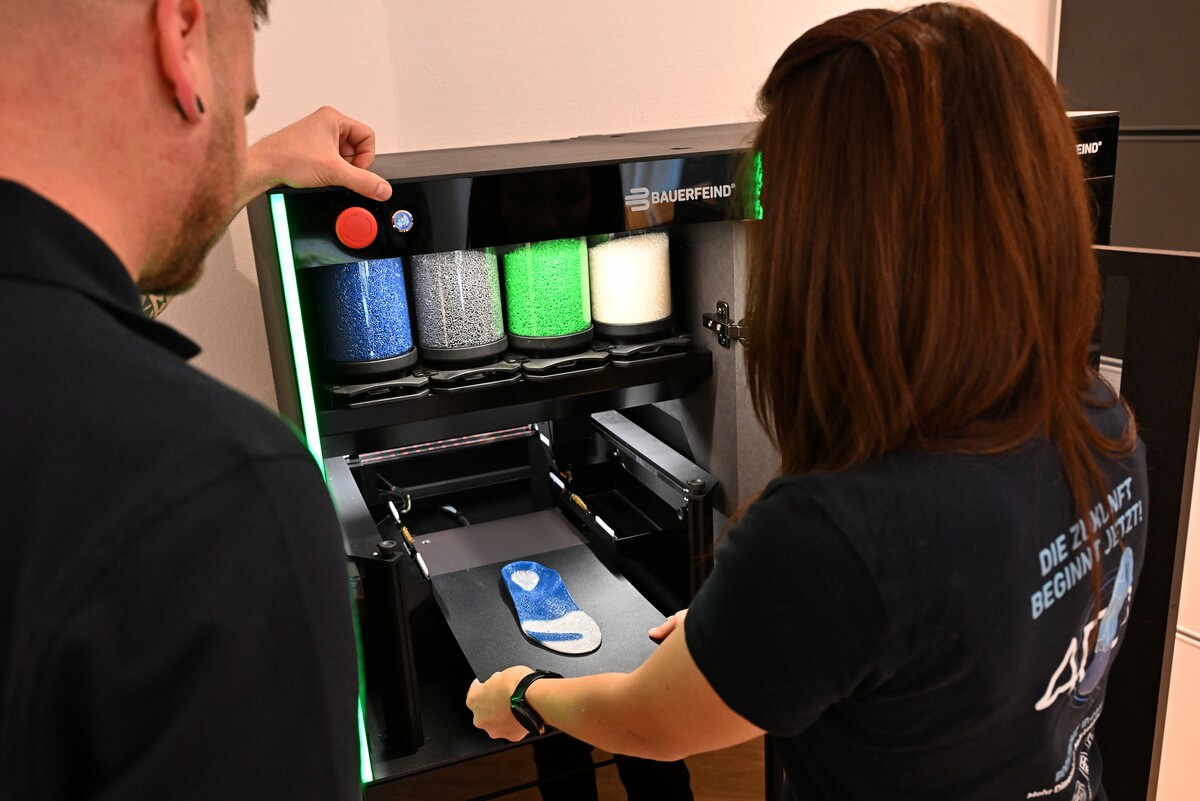
And you made a conscious decision to use pellet print. Why?
Michael: We tested various types of technology – we weren’t convinced by filament printing. Pellet printing was the best technical solution and the most economical in the end. Pellets are fine-grained plastic granules. As opposed to filaments, they’re not threads but loose granules which are melted and turned into the individual foot orthosis layer by layer.
Michael, you switched from Technology to Product Management during the project. How did your role change?
Michael: I generally work in Production, primarily as a technical implementer at first. Today, I focus more on systems so I’m always checking whether what we’re developing is possible from a production point of view. Nadine is the BODYTRONIC ID:CAM Product Owner and manages the entire project.
Nadine, what was the biggest challenge this project posed?
Nadine: Not so much the technology but mainly the overall concept: How can we introduce the idea to the market? Who will be in charge of setting up the printers for the customers and take care of support? How do the processes work in the background? All that was new. Working with the Measurement Technology Department was key and incredibly useful. Without their support, we wouldn’t have been able to implement the project in that time.
What feedback are you getting from practical use?
Michael: Customers who enjoy technology are absolutely thrilled. But you really have to get into it – you can’t just press a button and it’s done.
Nadine: Our pilot customers in particular are giving us a lot of ideas and constructive feedback. The discussions are intense and highly constructive.

What can you tell us about current market developments?
Nadine: Demand is very high. For many customers, 3D print is not just a production process but a convincing marketing tool. There’s also huge potential internationally – even though the markets are very different. Since the launch, we’ve installed 25 printers for our customers in the DACH region, another 32 have been ordered and will be commissioned in the coming weeks.
Michael: It feels like we had this idea at exactly the right time. We would have really missed out if it had been any later.
Does Bauerfeind have a special role in the market in this respect?
Nadine: Yes, absolutely. We’ve noticed that our decision creates trust. When Bauerfeind offers 3D print, a lot of people think: This is the real deal. Our comprehensive service and training offer makes the overall package unique in the market. That’s how we eliminate reservations and can gently introduce different generations to additive production.