Providing open and honest information
Peggy Lindner, Germany
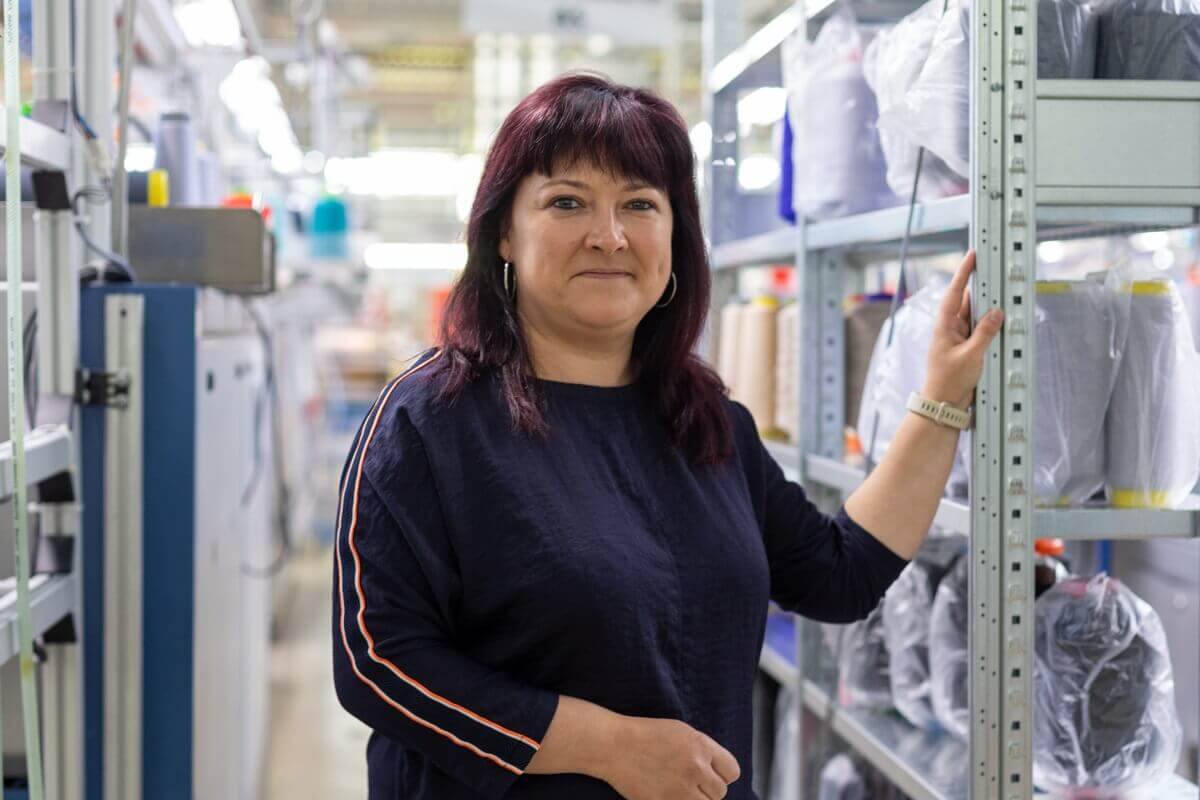
How do I tell my team that they need to be on short-time work? How can we comply with hygiene regulations? And how can we make the best of this situation? These are some of the questions Peggy Lindner has asked herself in the last few weeks. As the Knitting Team Leader, she coordinates the manufacture of the majority of flat knit products – that’s a lot of organizational effort. Open communication and a lot of coordination has helped Peggy Lindner to steer her team through the crisis.
They are responsible for the areas where almost all flat knit Bauerfeind products are made. Could you tell us a little bit about your typical workday?
I’m mainly busy managing my two teams consisting of 50 colleagues. I coordinate shifts, assign machines, help with patterns and pilot lots – all in all, there’s a lot of organizing to do. Previously, when the team was smaller, I used to join the knitting – but now, I don’t get around to doing that anymore.
Does that mean you would like to work on the machines yourself every now and then?
Yes, even just to stay up-to-date. I still often go to the production stations and talk to my colleagues – that way, problems are detected and solved early. We’re currently knitting wearing test samples for various Train products.
How are you able to continue your work in the usual way and still comply with hygiene and distancing regulations?
At the moment, the early and late shifts don’t meet: the teams are finishing a little earlier or starting slightly later. Everybody must keep a distance of 1.5 meters. That works quite well because each colleague looks after 4 to 7 machines, which means quite a large working area for each person. Masks should be worn if colleagues talk to each other for more than 15 minutes.
What are the challenges that the situation has brought about for you and your team?
Incoming orders continued to decrease, and it became obvious quite quickly that we had to start short-time work – of course, I had to explore ways to find a viable solution. I rearranged the shifts, in the Curaflow Team, we left out the night shift and some employees started to use up their overtime.
How did you explain to your team that there will be short-time work?
I asked everyone to meet. Initially, I felt a little uneasy. I know that this subject triggers uncertainty. I felt that it was important for me to speak openly and honestly with my teams right from the beginning, not sugarcoating anything – but, at the same time, I wanted to show how we can use the situation for our benefit.
Which advantages do you observe?
We can now train employees for additional work processes. In this way, they can develop, and we have more flexibility in responding to absences. And we’re servicing some machines. That can sometimes take up to 7 days per machine. Week by week, we’re now preparing for the current order situation, which, luckily, is going in a positive direction again.
About Peggy Lindner
Peggy Lindner is a textile machine operator by profession. She started her training with Bauerfeind in 1997, completed her master craftsperson training after her apprenticeship and has been the Knitting Team Leader in Zeulenroda, Germany, since 2007. She is currently responsible for 50 employees in the Flat Knit BS (support knitting) and Flat Knit BK3 (Curaflow custom-made production) divisions. Products manufactured there include those from the Train series, e.g. MalleoTrain, LumboTrain and EpiTrain. In addition, she supports the OK1 division (orthosis manufacture). In her spare time, she enjoys relaxing in her garden and going on bike trips with her family.