Never say never
Andreas Nitsche, Germany
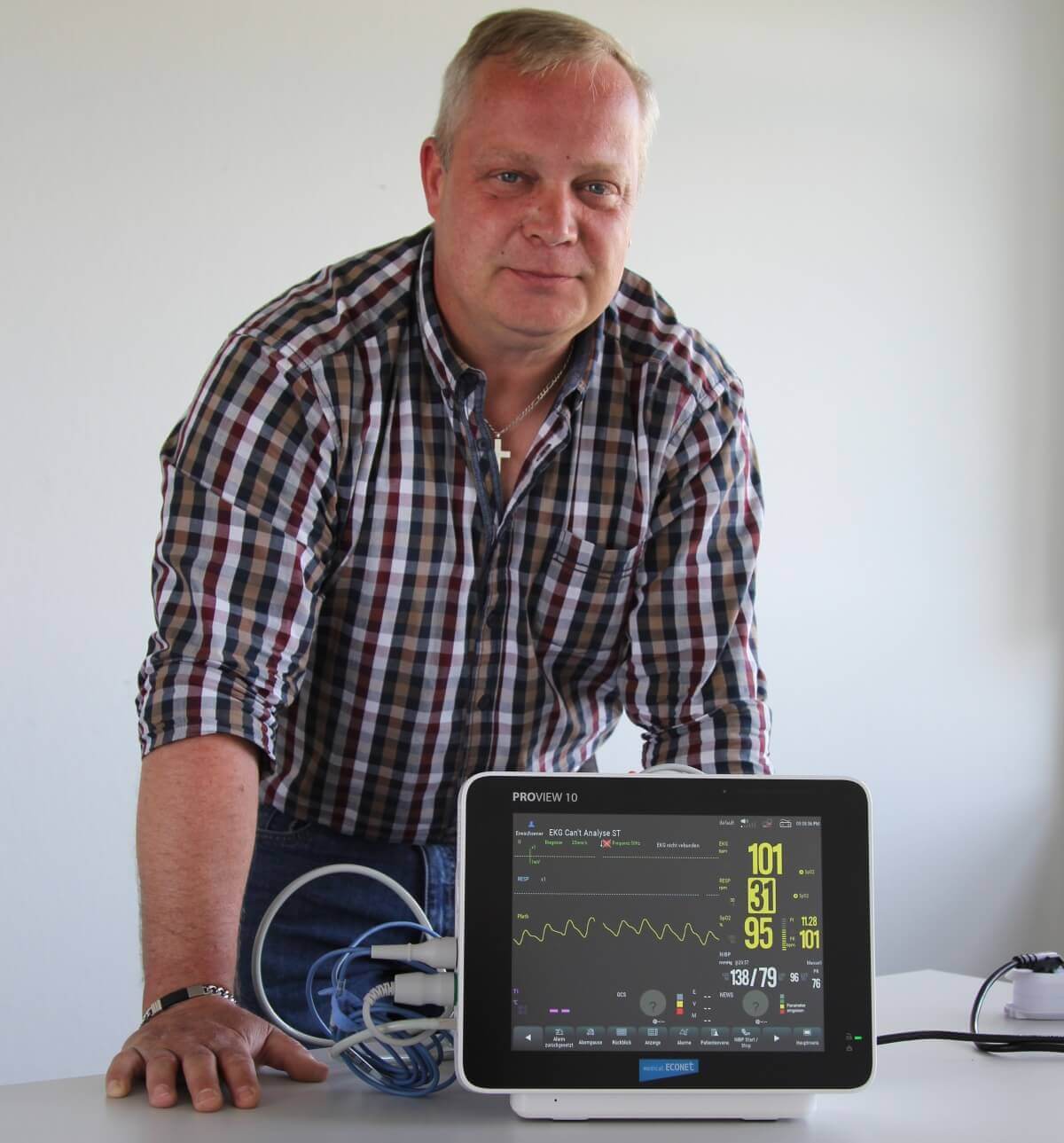
That is Andreas Nitsche’s motto. He tackles all sorts of things and doesn’t shy away from unusual experiences. His professional career also reflects this: two trades, seven medical qualifications, working for the military, for private businesses and in the ICU. In October 2018, Andreas Nitsche started to work for Bauerfeind in Property Management, now he is an in-house paramedic. This is all down to the 49-year-old’s medical experience – and very special circumstances.
Mr. Nitsche, some colleagues call you a “lifesaver”. How did this come about?
It was Fall 2018, and a Supervisory Board meeting took place for which I provided the Aramark catering. Professor Heinrich Hess, Professor Bauerfeind’s longtime companion, also attended. Suddenly, we heard all sorts of commotion and loud voices. It turned out that Professor Hess was in a life-threatening situation – of course, I helped him immediately and brought him back. Luckily, he was able to continue his work with the Supervisory Board soon after.
That sounds like it was just routine for you.
It wasn’t a big deal for me. After all, I have experience with this sort of thing. Not long after, I was asked if I wanted to work for Bauerfeind. Of course, I said yes! Since then, I’ve been in charge of occupational safety, I also do repairs, equipment testing and other tasks related to Property Management, and I’m the in-house paramedic.
Has your work changed because of the COVID-19 pandemic?
Yes, of course. In September, the first rapid tests became available, which I have been administering since then. I’ve previously done that, too, for example at the hospital to detect MRSA, a hospital superbug. That’s why taking nose and throat swabs, as required for the rapid COVID-19 tests, is just routine for me.
What is more important: patience or a steady hand?
Both. You have to be able to respond to the individual. Some are frightened and worried, they even shake. I can usually calm them down quite quickly. During the test, I make sure that the colleagues concentrate on breathing, and then I’ve pretty much finished with the swab anyway.
Does it happen regularly that you have to help in an emergency as the in-house paramedic?
Not as rarely as some may think. Between 2019 and 2021, we had various accidents and surgical injuries that had to be treated. Quite often internal medical problems, too, that affect the cardiovascular system. We’re better equipped now with a patient monitoring screen, enabling us to respond more effectively. If the worst comes to the worst, I can check the patient’s vital signs immediately and print them out for the physician on call – that can be crucial!
About Andreas Nitsche
Andreas Nitsche brings a lot of medical experience to Bauerfeind: during his time with the military, he was a paramedic, an emergency paramedic and a diving physician’s assistant. From 1994 to 1995, he supported the UN on a foreign deployment in Asia and worked in the ICU of Gera Waldklinikum for a total of 12 years. As the in-house paramedic, the 49-year-old has been in charge of carrying out rapid tests at the Zeulenroda site since the COVID-19 pandemic began. When Andreas Nitsche is not working, he assists the emergency services on a voluntary basis and helps during events as an emergency paramedic. To relax, he works in his garden.